- Home
- Trust center
The hard questions, answered up front.
School safety technology should earn the trust of everyone it touches. Here are the questions parents, staff, boards, and the community ask most, with straight answers, including what Steadfast can't do.
AI & camerasParents & studentsCommunityTeachers & staffSuperintendents & boards
What every district can count on.
Vetted people
U.S.-based analysts in our North Carolina operations center, background-checked to FBI CJIS Security Policy standards, on watch 24/7.
Government-grade security
The same security requirements we follow for DoD, first responder, and emergency services clients: CJIS, NIST SP 800-171 (CMMC), GCC High.
Your data, your rules
The district owns its data, sets retention, and can export it anytime. Never sold, and never shared outside without district approval or a court order.
No long-term contracts
Fully insured, custom-quoted, with an SLA available on request. You stay because it works, not because you're locked in.
A person decides
AI never acts alone. Every alert is verified by an analyst on live video before anyone is paged, a door locks, or 911 is called.
Built to stay up
Cameras record locally and cellular backup keeps alerts flowing if the internet drops. We watch system health and call you when something fails.
What people ask, and our answers.
About the AI and the cameras
Is this AI like ChatGPT?
No. Steadfast uses traditional computer vision and sensor analytics: software trained to recognize a few specific things, such as a visible firearm, a person climbing a fence, a vape signature in the air, or a door held open too long. People call that AI, but it isn't a chatbot like ChatGPT or Grok, it doesn't browse the internet, and it doesn't make decisions. It flags; a trained person decides.
For example, when a camera spots what looks like a rifle in the east lot, the software's whole job is to say "possible firearm, camera 4, 10:03:31" and put it in front of an analyst.
Where is our video processed? Does it go to the internet?
Detection and alerts are computed locally, on the cameras and sensors and inside our closed, secure system. Your video and alerts are not sent to public AI services or chatbots, and they never leave that system except to the people your district authorizes.
For example, a vape alert from a B-hall restroom travels from the sensor to our operations center and to the assistant principal's phone, and nowhere else.
Where do the cameras go? Do we have to put them everywhere?
No. Where cameras go is entirely the school's or district's decision. After the campus assessment, we recommend what to place where and why, and you choose. Cameras never go in restrooms, locker rooms, or changing areas.
For example, some districts put cameras only outside, on parking lots, entrances, fields, and bus loops, and use our sensors inside the building. Others add cameras in hallways and commons. Both work with the same analysts and the same response plan.
For parents and students
Is this turning school into a prison?
No. There are no cameras in restrooms, locker rooms, or changing areas, and nothing scans or tracks students as they go about their day. Steadfast watches for specific dangers: visible weapons, intruders, fights, smoke, vaping, and break-ins. On most days, nothing happens and nobody is bothered. What students see is a Protected Campus sign, not a guard at every door.
For example, a typical school day might produce a single alert: a side door propped open after lunch, closed by the front office in a minute.
What if the AI mistakes a phone or an umbrella for a gun?
The AI never acts on its own. Every alert goes to a trained analyst who checks the live video within seconds, before any lockdown, staff page, or 911 call. A false alarm stops with the analyst instead of turning into a frightening lockdown. That human check is the whole point of how Steadfast works.
For example, if a student's black umbrella is flagged as a possible rifle at 7:45 AM, the analyst sees it's an umbrella within seconds and dismisses it. Nobody is paged and nothing locks.
Could facial recognition misidentify my child?
Face matching is off unless your district chooses to turn it on, and it never compares against students. If it's on, it only checks visitors against a short list the district approves, such as a person under a trespass or court order. Face recognition can be less accurate for some people, which is why a person verifies every possible match before anyone acts.
For example, if a parent under a court order rings the front doorbell, the system flags a possible match, the analyst compares it with the photo the district has on file, and only then is the front office told.
Will alerts be used to punish students for minor things?
We recommend, and help districts put in writing, that Steadfast be used for safety, not routine discipline like dress code or tardies. For vaping, many schools pair alerts with health and counseling support instead of punishment alone. Your district decides, in policy, which alerts lead to what.
For example, a district might decide that a vape alert leads to a conversation with a counselor, and that video is never pulled to enforce dress code.
Is the system listening to conversations?
No. Sound sensors measure how loud a room is, not what anyone says, and audio recording is turned off in private spaces.
For example, a sudden jump to 90 decibels in a locker room raises an alert so a coach can check on it. The words are never recorded.
Who is actually monitoring the alerts?
Trained Steadfast analysts in our North Carolina operations center, around the clock. Every analyst is U.S.-based and background-checked to the standards of the FBI CJIS Security Policy, the same vetting required to work with criminal justice information for our first responder and emergency services clients.
For the community
Are license plate readers mass surveillance?
Plate readers sit only at school entrances and pickup lanes and alert only on plates your district flags, such as a vehicle tied to a protective or custody order. Every other plate is simply logged and deleted on your district's retention schedule. Plate data is never sold, and it is never shared with outside agencies, including federal or out-of-state agencies, without the district's approval or a court order.
For example, a car in the pickup line with a plate the district flagged under a custody order alerts the front office and SRO. The hundreds of other cars that day are only logged, then deleted on schedule.
Does AI weapon detection prevent school shootings?
No single tool prevents violence, and we won't claim otherwise. Weapon detection only sees firearms visible to a camera. What it adds is earlier warning and verified information when seconds matter. Most days, Steadfast earns its keep in other ways: catching vaping, break-ins, water leaks, and people who shouldn't be at the front door.
Some states ban facial recognition in schools. Does that matter?
Face matching is optional and only used where state law and district policy allow it. We review the rules with your district before anything is turned on.
Steadfast is run by law enforcement officers. Is this policing in schools?
Our founders' experience shapes how we write response plans and what we hand to responders. But the district controls Steadfast, not police: there is no standing police access to school cameras, video is shared only during an incident under the district's rules, and Steadfast never makes discipline or enforcement decisions.
For teachers and staff
Will cameras be used to watch or evaluate staff?
We recommend district policy that Steadfast not be used for staff performance evaluation, and every video view and search is logged so the district can confirm it.
For example, a principal couldn't search video to check what time a teacher arrived unless district policy allowed it, and that search would show up in the audit log.
Will this mean more lockdowns and disruptions?
It should mean fewer false ones. Alerts are verified by a person before anything reaches staff, and your district's playbook decides exactly when a lockdown happens.
For example, a delivery door propped open at 1:40 PM is closed by the office after the analyst checks the camera. No lockdown, no announcement.
How much training will we need?
Administrators and SROs get hands-on training at installation. Most teachers only need to know the panic button and the response plan, which we cover in a short session.
For superintendents and boards
What does it cost?
Every quote is custom, because every campus is different, and we reuse the cameras and doors you already have wherever we can. The campus assessment is free. E-Rate can help with the network side, and many districts fund safety upgrades through safety grants and capital budgets. Freedom Tech is SAM.gov registered for public procurement.
For example, a campus that already has good outdoor cameras might only need restroom sensors, a video doorbell, and monitoring.
Are we locked into a long-term contract?
No. There are no long-term contracts. Your district or school owns its data and can export it at any time.
Who is liable if something is missed?
Steadfast is one layer of safety, not a guarantee, and we document what each part can and can't do before you buy. Steadfast is fully insured, and proof of insurance is available on request.
How fast do you respond? Is there an SLA?
On average, an analyst reviews an alert about five seconds after it fires. A service level agreement is available on request.
What happens if the internet goes down?
Cameras keep recording locally, and cellular backup keeps alerts flowing to our analysts. We also monitor the health of your network, cameras, and doors, and we call you if something drops.
For example, if a storm knocks out a school's internet at 2 AM, the cameras keep recording, sensor alerts reach us over cellular, and we let facilities know about the outage.
How is the system protected from hackers?
We run Steadfast with the same security requirements we follow supporting Department of Defense, first responder, and emergency services clients: the FBI CJIS Security Policy, the NIST SP 800-171 controls behind CMMC, and Microsoft GCC High and FedRAMP-authorized cloud services where required. That includes multi-factor authentication, segmented networks, encryption, and logging of every access.
What about public records requests for video?
Video and logs are district records. Requests go to the district under its records policy and state law, and we help find and preserve what's needed.
More questions? See the full FAQ, our privacy commitments, or call (910) 920-0999.
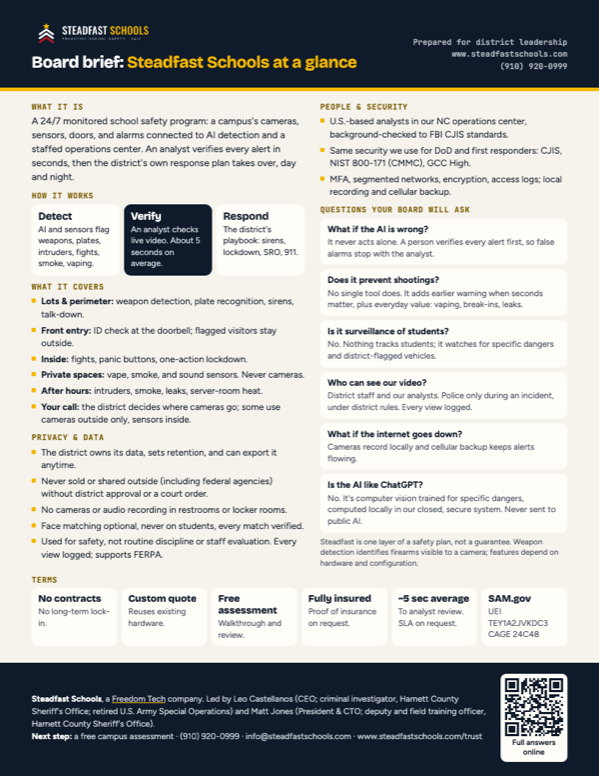
Get the one-page board brief.
A single printable page for superintendents and board members: how Steadfast works, what it covers, privacy and security commitments, terms, and short answers to the questions boards ask. Attach it to your agenda or hand it out at the meeting.
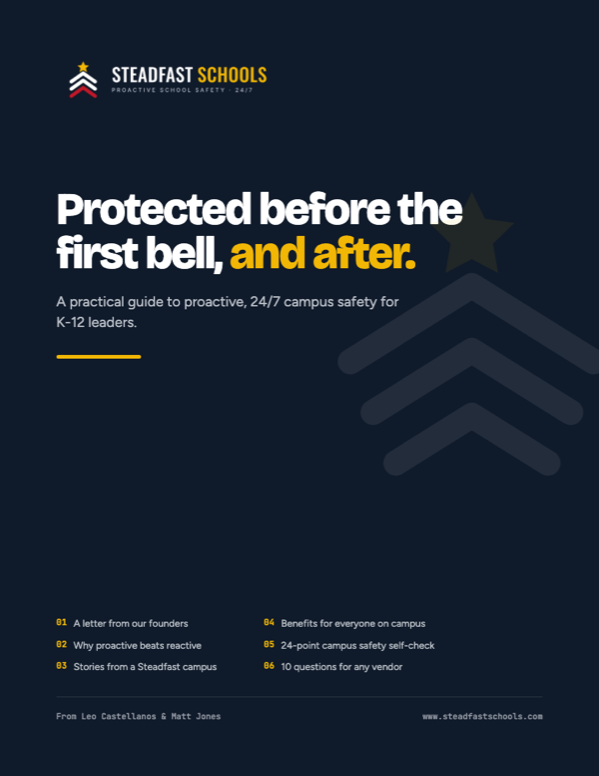
Protected before the first bell, and after.
Our free guide to proactive campus safety, with a letter from our founders, stories from a Steadfast campus, and tools you can use with your team this week.
- A 24-point campus safety self-check
- Benefits for leaders, SROs, staff, and families
- 10 questions to ask any school-safety vendor